
Deep-Seated Confusion
“You must unlearn what you have learned.” – Yoda

In 2018, not long after the McCarrick scandal came into the public eye, Rod Dreher published a provocative and disturbing account titled Inside The Seminary Closet, featuring the personal testimony of Gabe Giella, a gay man and former seminarian. Loudly defying any simple categorization by either conservative or liberal standards, Gabe described the deeply toxic environment of his seminary, how it was weaponized against him, and ultimately denounced the pervasive dysfunctional culture of sexual secrecy that lies “at the deepest core of the cover-up, abuse, and scandal of all forms – not just sexual – that continue to be rampant in these church circles.”
Of course, this is hardly a groundbreaking observation. Anyone who has closely followed studies on the sexual abuse crisis and reporting in recent decades already knows that secrecy and hypocrisy were a major component of the problem. Only five days after publishing Gabe’s testimony, Rod Dreher also published a personal account from Ron Belgau, further unpacking another key piece of the problem:
I was at the 2005 Courage Conference, where then-Archbishop O’Brien celebrated one of the Masses. After Mass, he approached a friend of mine and me, and asked us if we had considered studying for the priesthood. We both had. He encouraged us both to apply for the priesthood and said we should apply to become chaplains in the military (he was Archbishop of the Military Services at the time).
The following month, in his role as head of the 2005 seminary visitation, he told reporters that men with homosexual inclinations should not be admitted to the seminary, even if they had been celibate for more than a decade. Yet he had been recruiting at Courage, a conference for men and women struggling with homosexuality.
As Ron observed, this dynamic (“an environment where same-sex attracted men are widely recruited into the priesthood but face expulsion for any acknowledgement of their sexuality”) effectively “breeds a culture of duplicity… internalizing the lesson that sometimes, you do one thing, while telling the laity that you’re doing the opposite.”
And indeed, anyone with even a passing familiarity with the Church’s response to the sexual abuse crisis knows that transparency in the Church is chief among the reforms being continually called for by so many Catholics. And that is as it should be: for the obvious antidote to a culture of secrecy… is truth. We must announce the truth, hold ourselves and each other accountable, and live honestly as creatures of the light. Accordingly, when asked what his answer was, Gabe threw down the gauntlet:
I call on all Roman Catholic clergy to come out of the shadows about who they are. Those who have exploited sexuality through the perversion of pedophilia must come forward and go to the police. The bishops who know about them must turn their cases over to the police. All clergy — including bishops who are gay and celibate — must come out of the closet if they are to live with dignity, and if they are to acknowledge that their congregations have a right to the truth. This act could bring relief to the millions of Catholics who live closeted, shame-filled lives.
Priests who are not celibate must come forward and acknowledge it, and if they earnestly believe in the Church’s current teachings on homosexual relationships and celibacy, they must repent and stop. If they have simply been pretending to be celibate while not practicing celibacy, they need to acknowledge that they have been deceiving their congregations. If their behavior is due to their honest disbelief in the church’s current teachings, then they must be honest about that as well, and be open to the immense conversation and decisions that might result from that.
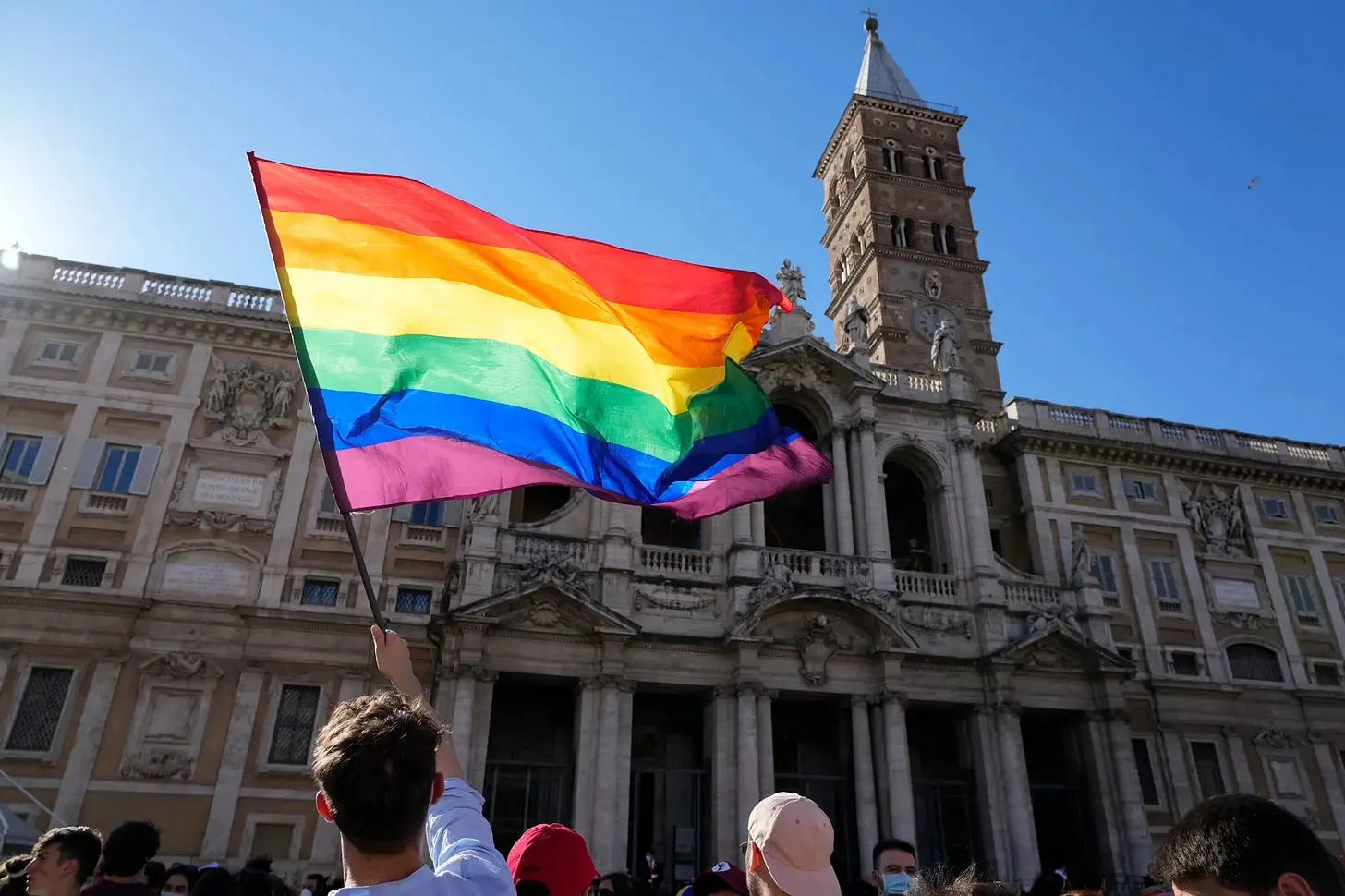
Bottom line: if priests were honest and/or stood up for themselves as they are, and not out of self-preservation against the very institution they represent, a tidal wave of change would happen. There would be a Pride Parade at the St. Peter’s Square if most of these men came out.
Now, I am not going to sit here and argue that Gabe’s solution is flawless. But I will say that my hesitations do not involve any disagreements with the principle of the matter – rather, I hesitate because I recognize that lived practical reality is rarely as simple as the true abstract principles. In other words, though I believe Gabe’s bold vision is close (indeed: very close) to fundamentally correct, I also believe that we must dismantle and reform dysfunctional cultures gradually. This is generally not the sort of project that can ever be prudently accomplished overnight.
Why? Because healthy reforms cannot be imposed by authoritarian coercion. We must sow seeds, and allow them to organically take root. Efforts to forcibly speed-run the process will inevitably entail causing new traumas, creating entirely new sets of problems to be solved. Indeed, the alleged right to know the truth is rarely simple, but must often be balanced alongside the true moral right to privacy that exists (within due limits) and cannot be entirely discarded without harm to the dignity of the person. And I have little doubt that Gabe would agree: we must avoid pressuring or coercing anyone (including clergy!) to “come out” especially if they cannot do so safely. So, to the extent that Gabe’s rousing vision is fundamentally correct – insofar as we should desire and aim to build up a culture that prizes truth and transparency, overturning broken cultures of secrecy and dishonesty – we must take the long view. Cultural reform, like personal reform, will generally be a slow process of conversion.
Another example worthy of long reflection (and prayer) can be found in Chris Damian’s 2025 An interview with a gay priest, where we meet “Father Peter”:
“Father Peter” is a current priest in the United States. He was seen as an exemplary Catholic during his adolescent years, and his peers and family were unsurprised when he joined the seminary. They didn’t know, however, that he was also attracted to other men and that his seminary formed him to hide the reality and nuances of these desires, both from others and also from himself. The reality of his disintegration was thrown into the light only after his first sexual encounter with another man. Today, he is an active pastor for a large Catholic parish. He is largely seen as “faithful,” “orthodox,” and effective as a pastor. But he also shared with me that he is not celibate, and he is processing what this means for him and his future.
Please keep in mind that the story of “Father Peter” is still in progress. He doesn’t have everything figured out. And his perspectives will likely develop over time. But he agreed to be interviewed, because he believes it is important for the Church to be aware of stories like his. Though he has loved being a pastor, his is a story often characterized by fear, shame, and disintegration. He believes the Church can and should do better, and that this begins by taking an honest accounting of reality.
I ask you to simply note how fear, shame, and disintegration lie at the heart of the deepest problems here. Those are the poisonous fruits of a dysfunctional culture of secrecy – those are evils that even secular LGBTQ+ Pride movements fight against – and those are what must be put to death: not by unbridled license, but by chastity.
Allow me to say it again: Chastity requires integration, and integration requires self-knowledge and acceptance, putting shame and repression to death. Repression is not chastity – it is the deadly enemy and perversion of authentic chastity, which is a life-giving habit of self-mastery. Again, similarly: “Shame can do more to hinder your development of chastity than specific sins, even if sins are to be taken seriously and worked against. […] To the extent that we develop true chastity, there will be more openness, freedom, integrity, and the ability to speak honestly about our experiences and share them with others and use them as a point of connection.” Or if you prefer, as Bishop Erik Varden wrote in Chastity: Reconciliation of the Senses (2024):
The essence of becoming chaste is not a putting-to-death of our nature, but its orientation, enacted through integral reconciliation, towards fullness of life. [p. 28]
Such work takes time. Patience is called for, and joy in every forward step. In terms of chastity, a quantum leap is made, for example, in progress from promiscuity to fidelity, whether or not the faithful relationship fully corresponds to the objective order of a nuptial union, sacramentally blessed, between man and woman. Every search for integrity is worthy of respect, deserving of encouragement. [pp. 122-123]
Herein lies a call to integrity and self-acceptance, to live with our longings, limitations and losses. We must accept the fact of being persons, turned towards and needing others, not self-sufficient individuals. We must accept our need to be saved: the disorder we carry is more than we can sort out on our own. Like musical instruments, we must be harmonized, rightly attuned by a pitch not of this world. The reconciliation of the senses is part of this enterprise. Chastity equilibrates it. It points, not to mindless mortification, but rather… ‘to wholeness, healthiness, unimpairedness, unity of the inner life, in general to the normal state of the inner life, to a person’s unfragmentedness and strength, to freshness of spiritual powers, to the spiritual organizedness of the inner man’. [pp. 160-161]
“So, how did we get here? The obvious answer is the devil.”
Thus wrote Francis Magister, a pseudonymous author, in a remarkably bad 2023 opinion piece for Crisis Magazine, wondering What Attracts Homosexuals to the Priesthood? I have no desire to dwell upon this at length; to my mind, it is self-evidently a deeply unaware, overconfident, and ultimately worthless conjectural essay. If you actually want to know what draws any group of people to the priesthood, then you should simply talk to real people and hear their firsthand accounts, or put in the work to conduct scientifically rigorous and statistically meaningful surveys.
But perhaps, ironically and by pure accident… Francis Magister was right? If the Father of Lies played any role in how we got here, then facilitating the injection of false pseudoscientific theories about human development into the popular Catholic understanding of homosexuality – encouraging Catholics to uncritically seize a particular moment in western secular psychology, and retain its errors under the false banner of “Catholic teaching” even after the psychological community recognized the harmful folly of that moment – thus crippling the Church’s pastoral response for many long decades… well, that sure seems like a plausible candidate to me.
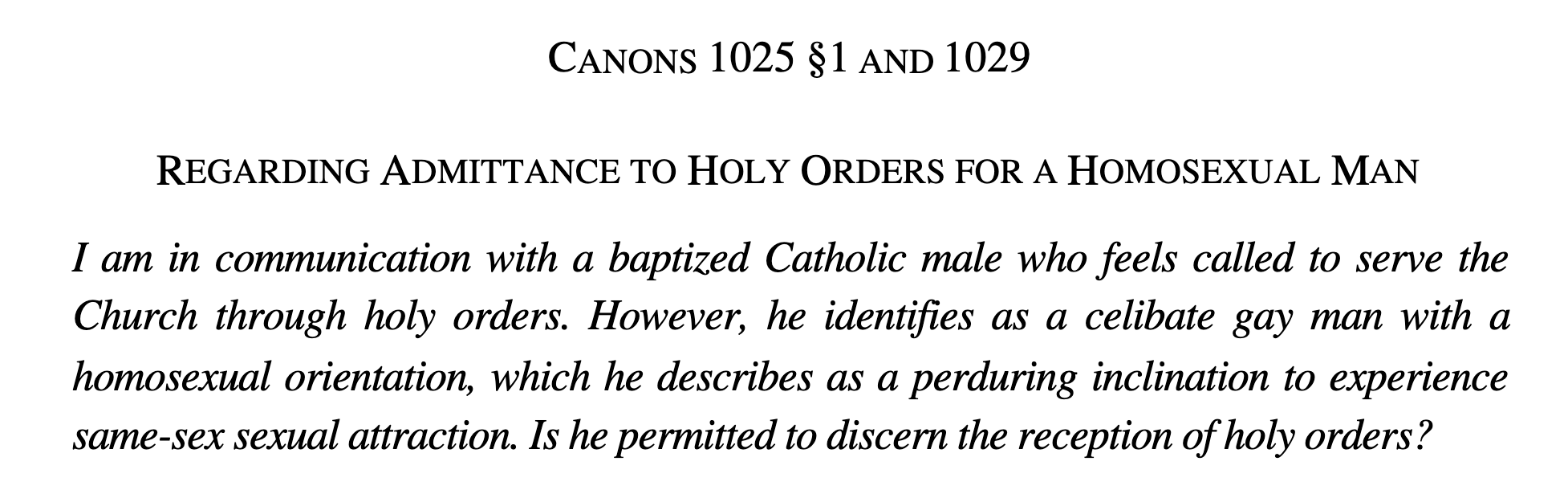
In an effort to coherently detangle the roots underlying this question, and help reset the conversation from a more productive vantage point, in 2023 I authored a lengthy Advisory Opinion for publication via the Canon Law Society of America: Regarding Admittance To Holy Orders For A Homosexual Man. If you wish to explore this topic at greater depth, I invite you to read the text at your own pace.
But in brief, the heart of my argument boils down to carefully articulating a subtle but immensely important philosophical distinction that is often entirely neglected. The very concept of “homosexual tendencies” is profoundly ambiguous, capable of being read broadly (as a tendency of desire) or narrowly (as a tendency of behavior).
Here it is worthwhile to pause for a moment and reflect on the critical distinction. Both desires and habits can be understood as types of inclination – both “draw” us toward particular actions, without inherently removing our freedom or determining us to those actions.
So desire is a sort of inclination to action; and habit is also a sort of inclination to action; but desires are not habits. These are fundamentally different realities, and we cannot simply collapse the distinction and speak univocally of “inclination” or “tendency” without additional specification. Consequently, there are at least four distinguishable categories that we must bear in mind:
A1. Concrete homosexual actions, which are (unquestionably) objectively disordered in the moral sense. This is how the text of the Catechism most fundamentally defines “homosexuality” – not primarily through the lens of sexual desire, but primarily through the lens of sexual actions.
A2. The inclination to engage in a pattern of action/behavior – a tendency of the will to habitually or otherwise easily consent to homosexual actions. This is how the Catechism seems to understand “deep-seated homosexual tendencies” (much the same as its moral antithesis: the habitual inclination of chastity that more or less easily resists consenting to illicit sexual desires). This behavioral inclination is also referred to as a propensity.
B1. Concrete desires or temptations to engage in homosexual actions: these may not be sinful (insofar as they are not willed or desired), yet they remain objectively disordered in the moral sense: insofar as they logically point or draw the person toward the inherently sinful action.
B2. The inclination to experience a certain pattern of desire – a tendency of the passions toward experiencing homosexual temptation or desire, on some sort of stable basis. This is how our modern culture seems to fundamentally understand sexual “orientation” (not as innate behavior, but as innate desire).
The Catechism’s treatment of “homosexual persons” approaches the “homosexual condition” fundamentally through the lens of a behavioral inclination [A2] toward engaging in a certain kind of sexual action [A1]. This is not incoherent, but (as will be argued) risks incoherence when placed into dialogue with a modern notion of “sexual orientation” [B2] that is more fundamentally defined by an experience of desire [B1] with no necessary implication that the desire must result in action [A1].
It may seem obvious or tempting for the modern reader to interpret “deep-seated tendencies” as the Catechism’s version of “sexual orientation”, but this would be incorrect, and leads to incoherence. For while an orientation or inclination [B2] to experience disordered sexual desires can logically coexist with true chastity, a behavioral propensity or inclination [A2] to engage in disordered sexual actions is inherently opposed to true chastity. We simply cannot equate these categories [A2 and B2] without sowing deep confusion across multiple questions.
And then either before or after reading that – or heck, maybe even instead of reading it (I can’t tell you what to do, I’m not your mom) – I invite you to listen to my recently-published interview with Chris Damian unpacking and discussing the same text.
Can Catholic seminaries admit gay men to holy orders? In this long, nerdy, and surprisingly hopeful conversation, I sit down with my friend Dan Quinan, a canon lawyer, to unpack what Church law actually says about “homosexual tendencies,” “gay culture,” and seminary admissions. We walk through the 2005 Vatican instructions; the difference between actions, habits, and desires; and why canon law cares far more about chastity and double lives than about labels like “gay” or “homosexual.” We also talk about Pope Francis, the Italian bishops’ recent proposals, and how pathological frameworks around sexuality have fueled both confusion and abuse. If you care about vocations, gay Catholics, canon law, or just understanding what the Church really teaches beyond the hot takes, this one’s for you.
Supplement I: Pope Francis
Following the publication of my Advisory Opinion in 2023, Catholics experienced a bit of… let’s call it “turbulence”… when headlines broke in 2024 that Pope Francis had reportedly used a homophobic slur during a closed-door discussion with the Italian bishops. And yet, overall, many felt an aura of humor about it:
The Pope’s initial comments drew widespread criticism, but among my cohort of irony-poisoned gay men in their twenties and thirties, everyone seemed to find it perfectly charming. The word “frociaggine” is just too delightful to inspire serious offence. It sounds like a fabulous cocktail that becomes the drink of the summer or a special variety of pizza you can only find in Abruzzo… In the memes that followed the Pope’s outburst, there was also the sense (largely tongue-in-cheek) that he had earned the right to say it, in the same way we might grant this privilege to Charli XCX… Some people also argued that his relatively decent record on LGBTQ+ rights should be seen as a mitigating factor… But I like the fact that we (more or less) collectively decided to find this funny.
Still, there was tension, as Tony Ginocchio humorously articulated:
See, the Pope doesn’t speak Italian very well, except he’s spent the last eleven years living in a place where everyone’s primary language is Italian. The Pope was repeating the term because someone else in the meeting had used it, except that conjures up an image of the Pope going “faggotry, yes, thank you, that was exactly the word I was looking for”. The Pope’s remarks were taken out of context, but it’s hard for me to imagine a context where I could use that word in a work meeting and not get immediately fired. The Pope maintains his welcoming stance towards queer Catholics, except he was in a meeting where he was explaining that he absolutely did not want gay men entering the seminary. The Pope wrote to a gay man expressing his regret that the man couldn’t enter the seminary, except the Pope is literally the guy keeping him out of seminary. But whatever, whatever, let’s just assume we can take all of that at face value and the Pope made some sort of Curb Your Enthusiasm-level faux pas in a work meeting, I guess I can go along with that. It was a stupid story, but it was kind of a funny story, and I could laugh at it and move on with my day. And then the Pope did it again.
Yeah, a second time! A second slur hit the towers! Reportedly on June 11, well after the media furor from when he said it the first time! It doesn’t appear to be the only thing he talked about during the meeting, but you’d still hope that, after getting into so much trouble, he’d make some bare minimum effort not to say the slur again. […] Think about the gay aspiring priest that Pope Francis wrote to, telling him to “thank you for writing to me, you are loved by God, go get em tiger” before almost immediately going to another meeting and saying “yeah guys, turns out we’ve still got a problem with the faggotry”. It’s difficult for me to read this series of events as anything other than cruelty. But I suppose if I’m trying really hard to be charitable…it might be dementia?
I want to take this occasion to dwell upon this drama at some length, because I think there is actually another, more compelling explanation: neither cruelty nor dementia, but a secret third thing, a subtle logic that explains (which is not to say justifies, but nevertheless: clarifies) how Pope Francis could seamlessly say “who am I to judge?” in 2013 while also speaking poorly of clerical “frociaggine” in 2024. Pay close attention to the context and circumstances of each of the following comments:
2013: “Who am I to judge?”
Answering a question about reports of homosexuals in the clergy, the pope answered, “If someone is gay and he searches for the Lord and has good will, who am I to judge?”
In what’s being called an unusually broad and candid news conference, Francis took questions from reporters for more than an hour as he flew from Brazil to the Vatican; his plane landed Monday.
One question centered on recent reports in Italian media that accused the Vatican Bank’s Monsignor Battista Ricca of having an affair with a Swiss Army captain. In response, Francis said he looked into the reports but found nothing to support the allegations.
2018: “If in doubt, do not let them enter.”
In a 2018 interview, published as a book, Francis underscored that he was concerned about relationships between homosexual candidates for priesthood and other religious posts, who take vows of celibacy and chastity and then end up living double lives.
“In consecrated life or that of the priesthood, there is no place for this type of affection,” the pope said in the book. “For that reason, the church recommends that persons with this deep-seated tendency not be accepted for ministry or consecrated life.”
Francis had already made these concerns known to Italian bishops. In another closed-door session in 2018, reported by the Italian news media, Francis said men with “deep-rooted” homosexual tendencies should not be allowed to enter into seminaries.
“If in doubt, do not let them enter,” the pope told the bishops.
2024: “There is too much frociaggine in seminaries.”
The question regarding homosexuality and seminarians has been under discussion for some time by the Italian bishops’ conference, and according to Il Corriere della Sera, at their meeting in Assisi last November, they “had approved a new document ‘Ratio Formationis Sacerdotalis,’ not yet approved by the Holy See, regulating admission to and formation in [Italian] seminaries, in which they approved by majority vote an amendment that recognized the distinction between simple homosexual orientation and ‘deeply rooted tendencies.’”
This, the paper reported, meant “in substance, that a homosexual person could be admitted to the seminary if, like the heterosexual, he gave the guarantee that he knows how to live the discipline of celibacy. The implication is that it is more difficult for homosexuals because they will be living in an all-male community for many years.”
…According to La Repubblica, Francis said that “it is necessary to put down markers, and prevent the risk that the gay person who chooses the priesthood could later end up living a double-life, continuing to practice homosexuality, while at the same time suffering from this dissimulation.”
In 2013, Pope Francis’ comment emerges within the context of Italian media reports about a Monsignor having an affair with a Swiss Army captain: he looked into the reports, but found nothing to support the allegations. Therefore, with no evidence of the Monsignor living a double life – that is, no evidence of any failure to live chastely – Francis responds to another question about homosexuals in the clergy: “If someone is gay and he searches for the Lord and has good will, who am I to judge?” In another account, he states clearly: “The problem is not having this orientation.”
In 2024, Pope Francis’ comment emerges within the context of the Italian Episcopal Conference developing (correctly!) a distinction between simple homosexual orientation and ‘deeply rooted tendencies’ – i.e. the very same fundamental distinction that I have been hammering upon. And critically, the initial media reports about Pope Francis somehow opposing that distinction were simply false:
Last November in Assisi, the Italian bishops approved by a majority vote a text in which they distinguished between homosexual “tendencies” and “acts.” In the document on formation for the priesthood, the bishops did not bar homosexual men from entry to the seminary as such, instead only barring men who could not maintain the commitment to chastity.
Asked whether Pope Francis’ remarks to the Italian bishops’ assembly went contrary to that, Bishop Savino replied: “Absolutely no! The concern of the pope was essentially educative, in the sense of holistic, complete education of the person: You must be accompanied in a process of formation that permits you to be faithful to your ordination.”
The logic at play is subtle, but clear: the distinction between simple tendencies of desire (or “orientation”) and deeply rooted tendencies of behavior (or “frociaggine”) is correct. Francis’ consistent and explicit concern was with clerics failing to maintain chastity (“living a double-life, continuing to practice homosexuality”), and thus he opposed anything that would fuel a culture of sexual behavior in seminaries. Whether or not we judge Francis’ infelicitous phrasing as inexcusable, or ultimately humorous and forgivable, I do not particularly care. For in the end, though he supported erring on the side of caution, he was (correctly!) not opposed to the ordination of chaste homosexual men, but supported the distinction being drawn by the Italian Episcopal Conference, which was indeed approved by the Dicastery for the Clergy in 2025:
The Vatican has approved new guidelines for Italy that say that an applicant for the seminary cannot be rejected simply because he is gay, as long as he remains celibate.
The guidelines say that seminary directors should consider sexual orientation as only one aspect of a candidate’s personality.
They do not change the Roman Catholic Church’s teaching that “homosexual tendencies” are “intrinsically disordered,” and that men with “deep-seated” gay tendencies should not become priests. But they clarify that if a candidate remains chaste, his sexual orientation should not disqualify him from entering the priesthood.
Supplement II: Pope Benedict XVI
I addressed this summarily in my text, but I think it merits being expanded upon. If there is any real obstacle to my thesis, it comes via Pope Benedict XVI in his 2010 book-length interview with Peter Seewald, Light of the World:
Homosexuality is incompatible with the priestly vocation. Otherwise, celibacy itself would lose its meaning as a renunciation. It would be extremely dangerous if celibacy became a sort of pretext for bringing people into the priesthood who don’t want to get married anyway. For, in the end, their attitude toward man and woman is somehow distorted, off center, and, in any case, is not within the direction of creation of which we have spoken. The Congregation for Education issued a decision a few years ago to the effect that homosexual candidates cannot become priests because their sexual orientation estranges them from the proper sense of paternity, from the intrinsic nature of priestly being. [p. 152]
Building on this quote, many expanded arguments against ordaining even chaste homosexual men have been developed and defended by well-meaning theologians who are (one charitably presumes) attempting to understand the mind of the Church. One standout example in this regard is Kenrick-Glennon Seminary’s devastatingly terrible 2019 document Seminary Formation and Transitory Same-Sex Attraction: A Proposal – a veritable tour de force of what does logically follow if we abandon (or simply never actually notice) and thus collapse the critical distinction between tendencies of desire/attraction vs. tendencies of behavior/action. Thus, advancing a framework utterly and diametrically opposed to the deepest principles and final conclusion of my own interpretation, the document confidently proposes:
To become a healthy spiritual father as a priest, a seminarian needs to make a conscious sacrifice of the goods of natural fatherhood: marriage and family life. But to make a conscious sacrifice of those goods he needs to desire them.
The seminarian is, by virtue of his body, objectively oriented toward the goods of marriage and physical fatherhood. But he needs to be subjectively oriented to them as well. […] Fr. Earl Fernandes builds on this vision and specifies it further for the issue of seminarians who experience same-sex attraction:
…genital function, conjugal love, and natural fatherhood must be true sacrifices for the priesthood for the man to be considered suitable. For these things to be considered sacrificial, the candidate must be already attracted to them, not merely intellectually, but affectively. He must be oriented to them and desire them.
This is one of the central reasons why a man with deep-seated same-sex attraction cannot be admitted to or continue in seminary: he is not affectively oriented toward the goods of natural fatherhood and, therefore, does not experience their renunciation affectively, as a personal sacrifice, in the matter that chaste celibate priesthood and spiritual fatherhood require.
[…] In the case of a seminarian who experiences transitory same-sex attraction, the goal of formation is not to produce a “chaste gay man” — a man who identifies as gay but is committed to not acting on his inclinations. The goal is to have a man who desires the goods of marriage and physical fatherhood, willingly renounces those goods, and can still make a gift of himself as a man, to the Church as bride, in a way that will be fruitful.
[…] We are well aware that many priests who consider themselves to have deep-seated same-sex attraction were ordained before this Instruction was written or implemented. In articulating this line of reasoning we mean no disrespect to them. We honor the sacrifices they have made and the priestly service they have rendered and will continue to render. We welcome their reflections on what priesthood and fatherhood have meant for them. At the same time we affirm that the Instruction [from the Congregation for Catholic Education in 2005] has taught something essential about the interior characteristics of the priesthood, and that this insight must be applied to seminary formation going forward.
Allow me to say clearly: I am fully willing to believe that the authors of this document were arguing sincerely and in good faith. But I think there is no escaping the fact – manifestly on display throughout the text, and confirmed by the narrow list of authors in Chapter 6: Further Resources [pp. 85-89] – that they were woefully misled by the entrenched faction of authors promoting ex-gay theories and conversion therapy pseudoscience in the Catholic world. Of course, we should be empathetic to the ease with which anyone can be misled by these theories, as even the Congregation for Catholic Education (and thus by extension: Pope Benedict XVI) was at least partially misled by the “expertise” of Msgr. Tony Anatrella. But we must understand that this confusion is disturbingly pervasive and directly linked to the false human anthropology upheld by “experts” in the field of “reparative therapy” which is not and never has been an authentic part of the Church’s moral doctrine.
Indeed, the “affective renunciation” premise is deeply confused and irreparably flawed on multiple levels: for we know, with certitude, that the renunciation of marriage is not actually essential to the priestly vocation. If it were, the approved Eastern tradition (and rare Latin phenomenon) of married priests would be theologically incoherent. The Congregation for Catholic Education did not actually undermine this and teach some essential doctrine about the interior characteristics of the priesthood; even if it had wanted to try, it had no real doctrinal authority under the competence assigned to it by John Paul II’s 1988 Pastor bonus (nn. 112-116).
We cannot maintain that a married priest is radically flawed or insufficiently configured to Christ due to his “failure” to renounce or sacrifice marriage. Likewise, there is no true foundation for the idea that the priesthood of a celibate homosexual cleric is radically flawed due to his own “failure” to renounce marriage. Nor, in truth, is any heterosexual candidate ever actually required to first positively desire marriage in order to subsequently renounce it as a sacrifice. Nothing prevents an asexual man from being a healthy spiritual father. This is a grave and unforced error. The laws of the Church do not regulate our involuntary internal affections – not even in marriage!1 – rather, they regulate our voluntary external behavior. Focusing on the subjective sacrificial renunciation of affective attraction is simply the wrong analytical framework for approaching the priestly vocation, through and through.2 It falsely envisions celibacy in a primarily negative manner (first and foremost as sacrificially renouncing a natural good) rather than as a higher good in its own right that can and even should (1 Corinthians 7:8-9) be voluntarily embraced for its own sake.3
In the end – if only on this one singular, remarkable occasion – Benedict answered very poorly. His commentary in Light of the World here amounts to an objection built on sand. Of course, he was not entirely wrong; he was correct to hold that:
The selection of candidates to the priesthood must [be] very careful. The greatest attention is needed here in order to prevent the intrusion of this kind of ambiguity and to head off a situation where the celibacy of priests would practically end up being identified with the tendency to homosexuality. [p. 153]
There is nothing wrong with desiring to prudently minimize risks, or even with erring on the side of caution “if in doubt” as Pope Francis encouraged. Indeed, there is no right to receive holy orders (CCC 1578), and it is entirely correct that holy orders should not be treated simply as a “default” vocation for everyone who lacks a positive desire to contract marriage. Dismantling our popular but overly-rigid imagination of the number of authentic Christian vocations in the Church is a vital component of this project. But caution and great attention are also required to head off the danger of situations in which the celibacy of Catholic priests would practically end up being identified with the tendency to pederasty, or to concubinage with women. Cultivating a pervasive culture of secret heterosexual sin in the Church would not be meaningfully better for the integrity or credibility of the celibate priesthood.
Similarly, Benedict was broadly correct to observe that:
If someone has deep-seated homosexual inclinations — and it is still an open question whether these inclinations are really innate or whether they arise in early childhood — if, in any case, they have power over him, this is a great trial for him, just as other trials can afflict other people as well. But this does not mean that homosexuality thereby becomes morally right. [p. 152]
Yet note well that curious middle clause – if his inclinations have power over him – because that is the whole ballgame. Given the overwhelming evidence that sexual orientation is at least relatively fixed, the question of whether or not it arises from nature or nurture in childhood is a distraction: if the inclination is here to stay, then it does not matter where it came from. The only thing that matters now is how you respond to it: governing your passions, or allowing them to govern you. Either the homosexual person labors under a form of compulsive sexual behavior that is inherently opposed to habitually maintaining the self-mastery of chastity – or he does not. Either the homosexual person is fundamentally capable of chastity, as the Catechism itself affirms (CCC 2359) – or we succumb to the despairing vision of conversion/reparative therapy whispering that authentic chastity (and thus also: any vocation to holy orders) is inaccessible to the homosexual person as such, at least unless or until his “affective orientation” appears to be fundamentally changed.
Of course, we should prefer to give a favorable interpretation to Pope Benedict XVI’s comments, insofar as possible (CCC 2478). But the core principle being cited – the idea that “their attitude toward man and woman is somehow distorted, off center” because the homosexual candidate inherently lacks the “affective maturity [that] will allow him to relate correctly to both men and women, developing in him a true sense of spiritual fatherhood towards the Church community” – absolutely reeks to high heaven of the outdated Freudian theory of human development (according to which homosexuality was an arrested phase in the process of psycho-sexual maturation) that was uncritically seized and preserved by Catholic leaders even after the psychological community recognized the harmful folly of that moment.
The simple antidote is recognizing that any priest or candidate for holy orders who lives a double life and habitually engages in illicit sexual activity – even a heterosexual one! – is objectively “in a situation that gravely hinders them from relating correctly to men and women”. The true obstacle to affective maturity is habitual vice – lust, which by its nature distorts our relationship with other persons – not any particular pattern of longstanding temptation. Affective maturity is obtained precisely via the virtue-habit of chastity, not via orientation change. As Bishop Erik Varden observed:
Chastity schools our loves. We learn in and through it that “in love, we find ourselves by giving ourselves.” Lust disintegrates us so that we can neither give nor receive. This giving and receiving is at the heart of both marriage and consecrated life because it is a matter of gift and, as the bishop writes, “the living water gushing up within us is made to be outpoured, not to be damned up.” We live in a contraceptive culture that damns up any form of self-gift leaving us with sterile selves. We must reorient ourselves entirely if we are to rediscover the gift of chastity in whatever state of life we are called to.
So-called “spiritual paternity” and “spiritual maternity” will then blossom as the natural fruit of that integration, as Pope Saint John Paul II observed: “the celibate person becomes spiritually fruitful, the father and mother of many, cooperating in the realization of the family according to God’s plan” (Familiaris consortio, n. 16).
Oh, and one final thing, the real cherry on top of this little dumpster fire of confusion. The entire context of this book-length interview between Pope Benedict XVI and a German journalist? That is not an authentic magisterial text with any real doctrinal-canonical weight. It was not even a lowly papal homily. It was the Pope’s educated but casual opinion, perfectly fallible, standing or falling on its own merits, with zero authority to bind consciences, not even remotely qualifying as an object requiring “religious submission of intellect and will” (CIC canon 752). Anyone treating this as an expression of Catholic doctrine does not understand what they are talking about. I am a fan of Pope Benedict XVI, but the man is allowed to make a mistake or two.
Supplement III: Cardinal Ratzinger
This one may seem irrelevant, but I promise it sheds further light on what is coming. There is a highly instructive example of an occasion on which Cardinal Ratzinger supported a strict restriction on holy orders… only to soften it a few years later.
In 1995, writing as Prefect for the Congregation for the Doctrine of the Faith, Cardinal Joseph Ratzinger issued a Letter to all Presidents of the Episcopal Conferences concerning the use of low-gluten altar breads and mustum as matter for the celebration of the Eucharist (19 June 1995) communicating a handful of norms, including:
Given the centrality of the celebration of the Eucharist in the life of the priest, candidates for the priesthood who are affected by celiac disease or suffer from alcoholism or similar conditions may not be admitted to holy orders.
Now, canonically, this appears to have been a fairly peculiar situation: for in the absence of special approval by the Pope in forma specifica (which this letter did not have) the CDF does not have legislative authority, and thus could not create/impose a new canonical irregularity or impediment, or otherwise definitively interpret a formal restriction that would absolutely prevent bishops from accepting such candidates for holy orders. Rather, it seems this letter would have been canonically interpreted as offering administrative norms akin to (if not precisely, although authors do not seem unanimous) either a general executory decree (CIC canon 33) or an instruction (CIC canon 34)… the regulations of which in either case do not derogate from the law, have no force if they cannot be reconciled with the provisions of the law, and only retain their force to the degree that they have not been explicitly or implicitly revoked. In other words: despite how the phrase “may not be admitted to holy orders” might look to casual readers, the CDF did not abruptly create any new legal irregularity or impediment to holy orders via the norm of its 1995 letter. It merely provided a regulatory guideline giving more concrete determination to how bishops should understand and interpret the broad “requisite qualities” and/or “physical and psychological qualities appropriate to the order to be received” (CIC canons 1025 §1 and 1029) for candidates. Still, a fairly shocking and restrictive guideline!
And yet only 8 years later, in 2003 – still writing as Prefect for the Congregation for the Doctrine of the Faith – Cardinal Joseph Ratzinger issued a new Circular Letter to all Presidents of the Episcopal Conferences concerning the use of low-gluten altar breads and mustum as matter for the celebration of the Eucharist (24 July 2003). Explaining that “in light of the experience of recent years, it has been deemed necessary at this time to return to the topic, taking up the above-mentioned documents and clarifying them”, Ratzinger affirmed that “attention should be paid to medical advances in the area of celiac disease and alcoholism”, and revised the previous restriction as follows:
Given the centrality of the celebration of the Eucharist in the life of a priest, one must proceed with great caution before admitting to Holy Orders those candidates unable to ingest gluten or alcohol without serious harm.
And this is how it happens. Not with a wholesale reversal of the underlying concern, but with a gentler reform that officially softens the interpretation of the law. Building on experience and scientific advances to ease a too-rigid restriction into a much more reasonable caution, while naturally reaffirming the freedom of bishops to discern when the “requisite” and “appropriate” qualities are sufficiently satisfied in individual cases, absent an explicit legal impediment or irregularity.
This, in all probability, is how the Congregation for Catholic Education’s 2005 Instruction Concerning the Criteria for the Discernment of Vocations with regard to Persons with Homosexual Tendencies in view of their Admission to the Seminary and to Holy Orders will be unwound: eased into a much more reasonable caution, invoking the experience of recent decades, affirming that attention must be paid to scientific advances in the area of human psychology, and definitively clarifying that the legal understanding of “deep-seated tendencies” must refer to behavioral tendencies, not merely to simple orientations of desire that are fundamentally compatible with chastity.
“On a long enough timeline, we win.”
Repeating myself one final time: The Church’s deep commitment to the principle that truth cannot contradict truth entails that Catholic doctrine is, by its very nature, fundamentally hostile to the preservation of any errors. In time, the zombified psychological claims that cling to the Church like a fraudulent appendage will be cut off, and the Church will finally be free to preach and apply its basic moral principles in light of the corrected scientific understanding. The tendrils of Freudian psychology are old(-ish) but they are shallow,4 and there are relentless glimmers of hope5 even prior to the arrival of Pope Francis. The Catechism itself naturally opposes them, and ultimately provides all the tools we need to identify a healthy virtue-based lens based upon behavioral tendencies connected to chastity as a virtue-habit.
Nevertheless, the text of the 2005 Instruction remains objectively muddy and ambiguous, and the misguided belief that the text is “clear” persists.6 The phrase “deep-seated homosexual tendencies” is never rigorously defined, allowing different readers to confidently project their own definition upon it, assuming it obviously means what they think it means. Nor do I have the authority to sit here and singlehandedly announce one definitive interpretation. If you really want to insist on reading the text through a scientifically outdated and theologically toxic lens – understanding “affective orientation” as an essential component of authentic chastity, and/or supporting the idea that all homosexual behavior is fundamentally compulsive and thus incompatible with true chastity – you can do so. And in that case, the 2005 Instruction is simply an error that must be entirely discarded.
But if you want to press deeper – if you want to simply discard the false Freudian anthropology of human desire, but then affirm whatever deeper truths can be affirmed in the text and ultimately salvage them – there is also a simple lens through which the text remains undeniably muddled and imperfect and in need of clarifying reform… but not entirely wrong, still fundamentally capable (with difficulty) of being harmonized with the truth. We can distinguish affective tendencies from behavioral tendencies, and then loudly affirm that the only “healing” actually required for holy orders is the self-mastery of chastity, which by its nature orders and inclines the person to habitually act in accord with the natural law, despite any internal impulses. That is the universal moral mechanism and authentic framework for relating correctly to both men and women in priestly celibacy. And indeed, we need not deny that any deep-seated lack of self-control in response to involuntary sexual desires is certainly a form of immaturity that all persons are called to overcome, regardless of their sexual orientation.
Either way, we have work to do.
Sentence of the Roman Rota coram Burke, 29 April 1993: “The validity of marital consent cannot depend on the intensity of feelings of love then present, or on the capacity to have and maintain such feelings later on, for there is no essential marital right or duty to feelings of love. The incapacities contemplated by c. 1095, 3° do not include the inability to have feelings, or to make one’s partner have them.”
Sentence of the Roman Rota coram Burke, 10 January 1995: “It is not the competence of the law to determine what degree of sexual attraction one party must be capable of having or maintaining towards the other. […] There certainly can be a valid exchange of conjugal rights and a valid marital relationship, despite dissatisfaction in sexual intercourse, little experience of sex, or little interest in physical sexual relations.”
It should also be noted that, while the chaste homosexual may not find it “burdensome” to renounce marriage, he remains fully capable of making a conscious and willing sacrifice of the worldly joys and sexual pleasures that the world encourages him to pursue. The fact that his renunciation of those illicit goods is morally required under pain of sin does not prevent him from freely and even joyfully adhering his will to that sacrifice, denying himself the pleasures of the world and the flesh for the sake of the kingdom. (For further reflection, see Aaron Taylor, Called to Celibacy Unchosen, First Things, 13 June 2013).
As Grant Hartley highlights, while reflecting on one of the etymologies of St. Isidore of Seville: “the words ‘celibacy’ and ‘celestial’ come from the same Latin root, caelum, which means ‘the heavens’. Celibate folks are caelobeatus, or “blessed in heaven,” because their lives are images of the lives of the angels, who according to Jesus ‘neither marry, nor are given in marriage’ [Matthew 22:30]. This means that celibacy can be a representation of our future resurrected state; celibacy now is an image of the glorious life all will live in the resurrection.” (Grant Hartley, Notes: Living a Life of Chastity, 3 July 2023).
Similarly, Kevin Slusher concludes: “Far from being a tragic life that must be pitied, Scripture gives a far different view of the life of the sexual minority committed to celibacy… Certainly we should not diminish that a life of celibacy has tragic elements of darkness, of struggle, of suffering. But the celibate life is not ultimately defined by tragedy, by what is given up, by what is lost. It will be defined by what is gained in the promise of God.” (Kevin Slusher, Celibacy: Tragedy or Deep Comedy?, Spiritual Friendship, 27 April 2018).
Over 50 years ago, the Sacred Congregation for Catholic Education published A Guide to Formation in Priestly Celibacy (11 April 1974) offering many very reasonable guidelines. But in a brief section on sexual maturity – with no other mention of homosexuality in the entire document whatsoever – it casually dropped the following wildly archaic claim:
In order to talk about a person as mature, his sexual instinct must have overcome two immature tendencies, narcissism and homosexuality, and must have arrived at heterosexuality. This is the first step in sexual development… [p. 22]
Now understand this: under the competence assigned to it by Paul VI’s 1967 Regimini Ecclesiae universae (nn. 75-80), the Sacred Congregation for Catholic Education did not hold any legislative or doctrinal authority. Indeed, the text of the Guide is incredibly self-aware about the “nature and purpose of these guidelines” [p. 7] precisely seen as guidelines, and furthermore it recognizes that “the human sciences – education, psychology and sociology – are in a continual state of development” [p. 9] which in turn necessitates that:
All human institutions which proclaim lasting values… must undergo periodical up-dating. Priestly values, precisely because they are permanent and imperishable, must be considered in the context of a pilgrim Church moving towards the Risen Lord. These values must be expressed in a way that is suited to the present age. [p. 9]
My point is this: when our modern Dicastery for Catholic Education is finally ready to wake up and set aside the zombified psychological theories that drove its guidelines in 2005, it can… literally just take its own advice. It already has at hand all the principles it requires to incorporate scientific updates, and provide a new formulation suited to the present age.
Over 30 years ago, The Pontifical Council for the Family – operating under the competence assigned to it by John Paul II’s 1988 Pastor bonus (nn. 139-141), and thus again not holding any meaningful doctrinal or teaching authority – published The Truth and Meaning of Human Sexuality: Guidelines for Education within the Family (8 December 1995):
104. A particular problem that can appear during the process of sexual maturation is homosexuality, which is also spreading more and more in urbanized societies. This phenomenon must be presented with balanced judgement, in the light of the documents of the Church... Especially when the practice of homosexual acts has not become a habit, many cases can benefit from appropriate therapy... If parents notice the appearance of this tendency or of related behaviour in their children, during childhood or adolescence, they should seek help from expert qualified persons in order to obtain all possible assistance…
Obviously, this is still not great: the Freudian concept of homosexuality as an arrested stage in the process of psycho-sexual maturation (and corresponding support for pursuing conversion therapy) is still on full display. Nevertheless, behold the casual but explicit emphasis being given to habitual actions and behavioral tendencies in the text: those are already the seeds of the corrected framework that I have been hammering upon.
A newly-released report from the University of Notre Dame’s McGrath Institute for Church Life (“Do You Know Them to be Worthy?”) alleges – outrageously – that the Vatican’s 2005 Instruction “explicitly excludes individuals with SSA from Orders” (p. 26). This is simply a falsehood; at maximum it may be one possible interpretation, but in no world is that interpretation even remotely “explicit”. Why? At the cost of repeating myself: because the Vatican’s 2005 Instruction does not explicitly address “attraction” at all. What it addresses is “tendencies” – a term that is actually (despite lacking any clear and explicit definition) both historically and theologically best understood with reference to behavioral tendencies (i.e. habits/vices, things that are per se incompatible with chastity). Relentless focus on “attraction” in this context should always be setting off alarm bells: because that is the toxic framework preferred by conversion therapists. And indeed, anyone familiar with this material could have predicted this error in the very moment that they recognized the name of Timothy Lock being listed as a contributing author to this report. When the terminology of “T-SSA” (transitory same-sex attraction) and “DS-SSA” (deep-seated same sex attraction) is employed, this is not faithfully reflecting the Vatican’s original text, but quite literally begging the question: quietly rendering “tendencies” as simple “attraction”, confidently assuming that this is obvious. But it’s not. And we are never going to be able to make real progress on this if we keep failing to recognize the sleight of hand.
I think the Side B vs. Side X/Y debate may have to do with a deeper disagreement among Catholics and Christians that extend to other matters as well (like non-Christian religions, or the secular culture at large). There can be the question of whether secular impulses can be worked with and “steered” in the right direction by apologetics/evangelism/conversion, or whether they should be thrown out and disparaged wholesale.
For example, your appeals to Erik Varden will be helpful from a certain perspective, but I could see a critic reading what he says and disagreeing with it, too. For example, when I saw him say “the essence of becoming chaste is not a putting-to-death of our nature”, an internal interlocutor in my head objected, because there are verses in Scripture about dying to oneself, and how the convert is a new creation, etc. The counterpoint may be that it's sin that must die, not our nature, but the deeper question and disagreement may be about just how thoroughly sin (be it original or actual, individual or cultural) corrupts our nature.
This difference can seem to manifest in apologetics as well. I'm reminded of this tweet which seems to criticize what he sees as excesses in (typologically-considered) “Side B” apologetics, of trying to steer the objector's intuitions in a Catholic direction versus emphasizing a decisive and radical change that needs to be made.
https://x.com/i/status/2064358832185249985